PARTICIPANT:�@�@
1998 PROGRAM
THE 1998 PROGRAM
28 interns from 17 countries participated in the 1998/US/ICOMOS International Intern Program. Exchanges continued Australia, Austria, Croatia, Germany, Lithuania, Poland, Slovakia, Turkey, the UK. and India; new programs were launched with Jordan, and Romania.
Other ICOMOS Internships were launched with Bulgaria, Georgia, Italy, Japan, and Netherlands.
The Historic American Building Survey/Historic American Engineering Record(HABS/HAER) placed US/ICOMOS interns on teams across the United States. Other National Park Service offices and institutions also hosted interns.
REPORT ON INTERNSHIP
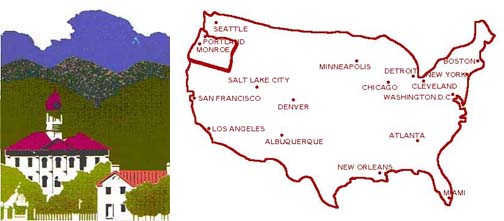
I worked at the Historic American Engineering Record(HAER) team documenting the Hull-Oakes Lumber Co. at Monroe in rural south Benton County, Oregon this summer.
In May, 1997, the HAER began this Project and will complete in later October, 1998.
Monroe is located about 100 miles South of Portland. Hull-Oakes Lumber Company is a saw and planning mill built in 1938-1939, and is still operation.
The Hull-Oakes Lumber Co. is a rare, operating, steam-powered sawmill processing large-diameter Douglas fir trees.
Our project began work on May 26, and finished on August 7. The fieldwork, measured drawings and photographs were prepared under the general direction of Richard O'Connor, Historian and Dana Lockett, Architect, of the HABS/HAER Division of National Park Service. The recording team consisted of Sara Beth Paschke, Field Supervisor; Corri Jiminez, Charles Bucher and myself.
For the first month we took measurements and made fieldnotes. We basically worked individually, because the project site is so large for 4 people. Therefore , when I was doing the fieldwork, I had to consider carefully what I needed to develop the measured drawings. The fact made me uneasy. Finally, I was able to understand the complicated saw mill system.
I feel the saw mill's process is more important than their buildings and machinery for cultural property. The thinking way like this is little bit different of Japan. And it is very interesting for me.
On my day off from the project I have been interested in cars. There are always various generations of cars to be seen on the street. In the US. there are also a large number of Japanese cars. So now I have seen old Japanese cars which I have never seen before.
In Japan I rarely see any cars which are more than 10 years old. We are obliged to have an automobile inspection every two years. The system is why old cars are rarely seen on the street in Japan. It is more expensive to have old cars in Japan, because of this inspection. In short I have seen the great diversity of Japanese cars in the US. and I have felt proud of the historical achievements of Japanese car makers.
Japan has a long engineering history including cars, electronics,and so on. But we do not consider these things as worthy of preservation. We have a tendency to think of the newer engineering as better.
In Japan, we should be aware of the historical importance of our engineering. This is one of the great achievement of Japanese people.
Samples
return to POSTER PAGE